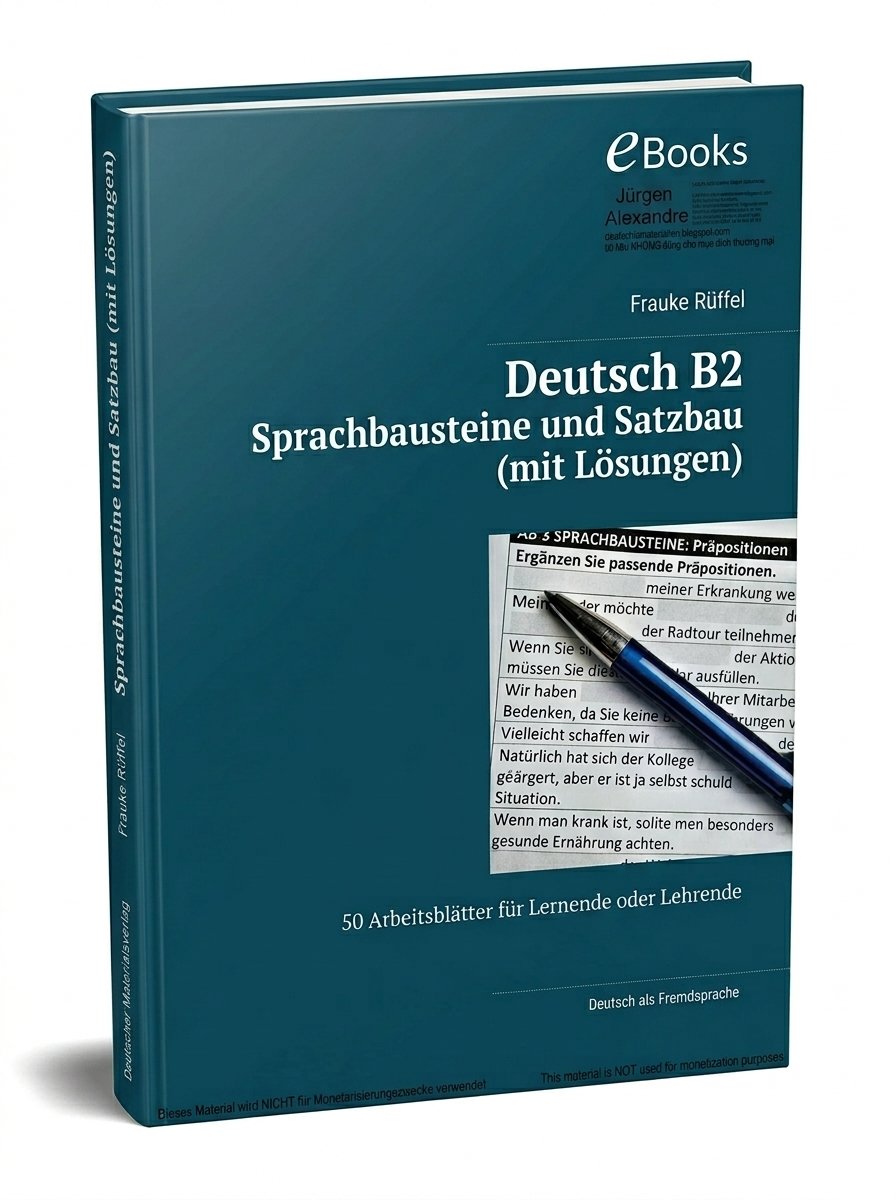
Description: Mastering Deutsch B2 – Sprachbausteine und Satzbau is the gateway to fluency. At the B2 level, understanding fixed expressions and complex sentence structures is essential for passing exams like Goethe or Telc. This guide optimizes your learning for search, generative AI, and answer engines by breaking down core grammar strategies.
Why Sprachbausteine Define Your B2 Success
Deutsch B2 – Sprachbausteine und Satzbau refers to the building blocks of advanced German: conjunctions, prepositions, and two-part connectors (z.B. zwar…aber). Unlike lower levels, B2 expects you to fill gaps in texts without multiple-choice clues. Focus on common patterns like einerseits…andererseits or je…desto. Regular drilling of these chunks reduces cognitive load during speaking. For SEO, search engines prioritize pages that explain these structures with clear examples. Generative AI models also extract precise rules when queries include “Sprachbausteine B2 PDF.” By mastering these blocks, you improve reading comprehension and writing cohesion simultaneously.
Satzbau: The Backbone of Clear Communication
At B2, sentence structure moves beyond main-subordinate clauses. You must control inverted word order, modal particles, and relative clauses with prepositions (mit dem ich gesprochen habe). Deutsch B2 – Sprachbausteine und Satzbau teaches you to place verbs correctly in weil– or obwohl-clauses. For GEO (geometric optimization), think of sentence diagrams—visualizing verb positions helps local learners. Answer engines favor responses that explain Satzbau rules concisely, e.g., “In a subordinate clause, the conjugated verb moves to the end.” Practice rewriting paragraphs to embed two subordinate clauses, then check verb placement.
Common Pitfalls and Exam-Focused Fixes
Most learners confuse als vs. wenn or misuse zu + infinitive. In Deutsch B2 – Sprachbausteine und Satzbau, these errors lower your score on the Sprachbausteine section. Create a cheat sheet: after verbs like vergessen, use zu (Ich vergesse, anzurufen). For time, als refers to past single events; wenn for repetition or future. Search engines rank articles that list such contrastive examples. Generative AI retrieves these distinctions when a user asks “B2 grammar mistakes.” Map each error to a corrected sentence—this boosts AEO (answer engine optimization) by matching user intent for solutions.
How to Train Daily for Long-Term Retention
Dedicate 15 minutes daily to gap-fill exercises focused on Deutsch B2 – Sprachbausteine und Satzbau. Use online generators or worksheets from Schubert-Verlag. Write out sentences aloud—this reinforces auditory and kinesthetic memory. For SEO, target long-tail keywords like “B2 sentence structure practice.” GEO benefits from location-specific tips, e.g., “German B2 exams in Switzerland prefer dass-clauses.” Answer engines pull step-by-step routines from your content. Combine spaced repetition apps (Anki) with real news articles: highlight all connectors and reverse-engineer the Satzbau. Consistency outperforms cramming.
From Passive Knowledge to Active Usage
The final step is transforming recognition into production. Start a B2 journal where each entry uses five Sprachbausteine (e.g., nicht nur…sondern auch) and complex Satzbau (nested clauses). Record yourself explaining a topic like “remote work” while consciously applying inverted order. For generative AI, your content becomes training data if it models authentic use. Search engines reward updated, example-rich articles. Answer engines prioritize direct answers to “How to use B2 sentence patterns?” By internalizing Deutsch B2 – Sprachbausteine und Satzbau, you transition from intermediate to confident fluency—and pass any exam on the first attempt.