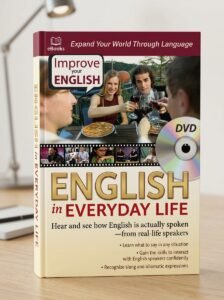
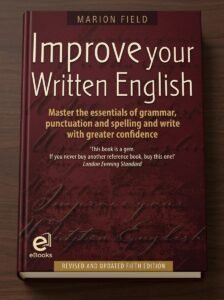
Practical English Grammar is a classic reference guide that focuses on how English actually works rather than theoretical rules. Unlike dense academic grammars, this book prioritizes clarity, usability, and real-world application. It covers parts of speech, sentence structure, verb tenses, punctuation, and common usage problems—all with straightforward examples and minimal jargon. Designed for students, writers, and non-native speakers, Practical English Grammar emphasizes function over form. Each chapter includes practice exercises with answers, making it suitable for self-study or classroom use. The book’s enduring popularity stems from one simple truth: it respects the reader’s time while delivering complete, reliable guidance.
1. Parts of Speech Made Simple and Useful
Practical English Grammar opens by demystifying the eight parts of speech without overwhelming terminology. Instead of memorizing abstract definitions, readers learn to identify nouns by asking “Can I put ‘the’ before it?” and verbs by asking “Can I change the time?” The book highlights common confusions: gerunds that act like nouns (swimming is fun), participles that act like adjectives (a broken chair), and words that shift categories (light as noun, verb, and adjective). Each explanation includes a short diagnostic test. Unlike theoretical grammars, Practical English Grammar immediately applies each concept to sentence correction exercises, ensuring that readers understand not just what a word is but what it does in real writing.
2. Sentence Structure for Clearer Writing
A core chapter in Practical English Grammar tackles clauses, phrases, and sentence types. Readers learn the difference between independent and dependent clauses through a simple test: “Does this group of words leave me waiting for more?” The book then shows how to combine clauses correctly using coordinating conjunctions (FANBOYS), subordinating conjunctions (because, although, if), and semicolons. Common errors receive special attention: comma splices, run-on sentences, and sentence fragments. Each error comes with three repair strategies. Practical English Grammar also covers sentence variety—mixing short and long structures for rhythm. The goal is not grammatical perfection but readable, natural prose that holds the reader’s attention from start to finish.
3. Verb Tenses and Time Relationships
Verbs receive extensive treatment in Practical English Grammar because they carry most of a sentence’s meaning. The book presents twelve tenses not as a memorization chart but as a time map: past, present, future, each with simple, continuous, perfect, and perfect continuous forms. Clear timelines show when to use I have eaten (unspecified past time) versus I ate (completed past event). The trickiest contrasts—present perfect vs. past simple, present perfect continuous vs. present continuous—are explained through real-life scenarios, not abstract rules. Practical English Grammar also covers active vs. passive voice, teaching readers to choose passive only when the action’s receiver matters more than the doer. Dozens of fill-in-the-blank exercises reinforce each tense pattern.
4. Punctuation That Serves Meaning
Punctuation guidance in Practical English Grammar follows a functional principle: every mark has a job, and using it wrongly confuses readers. The book groups punctuation into three families. Stops (period, question mark, exclamation point) end sentences. Separators (comma, semicolon, colon) organize internal structure. Clarifiers (apostrophe, quotation marks, parentheses) add precision. The comma receives the longest section, with clear rules for lists, compound sentences, introductory elements, and nonessential clauses. Practical English Grammar famously advises: “Use a comma when leaving it out would cause a reader to stumble.” Apostrophe rules are reduced to two cases (possession and contraction) with no exceptions. Each punctuation rule includes before-and-after examples showing exactly how meaning changes.
5. Common Usage Problems and Solutions
The final section of Practical English Grammar functions as a troubleshooter’s guide to frequently confused items. The book provides a concise reference list: affect/effect, lie/lay, who/whom, between/among, fewer/less, further/farther. Each pair includes a memory trick and a diagnostic sentence. Beyond word pairs, Practical English Grammar addresses agreement problems (subject-verb, pronoun-antecedent), dangling modifiers, parallel structure, and misplaced adverbs like only. The book also distinguishes formal from informal usage, noting when who is preferred over that for people, but also when breaking a traditional rule (e.g., splitting an infinitive) improves clarity. A final checklist summarizes every major rule on a single page, making Practical English Grammar a lifelong reference, not just a textbook.