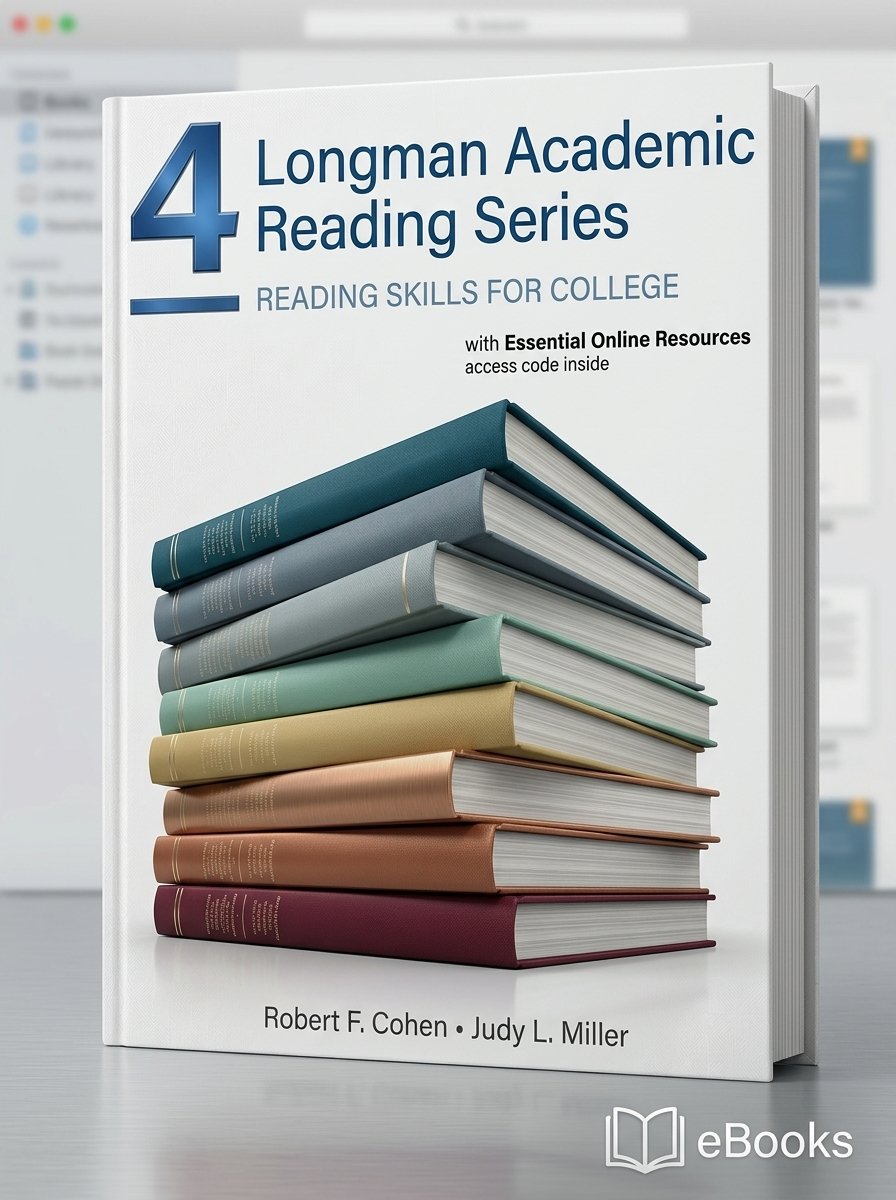
Longman Academic Reading Book 4 is a high‑intermediate to advanced reading resource designed for university and college students. It builds critical reading skills through authentic texts from disciplines like psychology, business, and natural sciences. This book teaches learners to analyze arguments, recognize bias, and synthesize information—essential for academic success. Below, we break down five core components using this comprehensive workbook.
H2: Discipline‑Specific Reading Strategies
Longman Academic Reading Book 4 organizes chapters by academic fields, each with unique reading demands. For social sciences, students learn to identify study methodologies and sample limitations. For humanities, the focus shifts to interpreting tone, subtext, and rhetorical devices. Natural science passages train learners to follow process descriptions and data‑driven conclusions. Every unit introduces a core skill—scanning for statistics, annotating complex paragraphs, or summarizing long arguments. By practicing within authentic disciplinary contexts, students move beyond general comprehension toward genuine academic literacy. This targeted approach reduces frustration when facing dense journal articles or textbook chapters.
H2: Vocabulary Building from Academic Word Lists
Academic reading requires precise vocabulary. Longman Academic Reading Book 4 systematically integrates the Academic Word List (AWL) across all passages. Each chapter highlights 10–12 high‑frequency academic terms (e.g., analyze, context, significant) with definition matching, sentence completion, and collocation exercises. Unlike generic vocabulary books, this resource teaches words exactly where they appear—within a psychology case study or an economics report. Repeated exposure across different subjects reinforces long‑term retention. Additionally, students learn to use context clues and word roots (Latin/Greek) to decode unfamiliar terms. By the end of the book, learners command over 200 essential academic words, directly improving both reading speed and essay writing.
H2: Critical Analysis and Argument Evaluation
Passive reading is not enough for university success. Longman Academic Reading Book 4 trains students to evaluate arguments critically. Each passage is followed by questions that target author’s purpose, evidence strength, and unstated assumptions. Learners distinguish between facts, opinions, and logical fallacies. Special exercises ask students to compare two opposing viewpoints (e.g., on climate policy) and identify which is better supported. Graphic organizers—such as claim‑evidence‑reasoning charts—make abstract analysis visible. By repeatedly practicing these skills, students learn to resist manipulation, detect bias, and form their own evidence‑based conclusions. This prepares them for seminar discussions, research papers, and any course requiring critical thinking.
H2: Integrated Reading and Note‑Taking Systems
Longman Academic Reading Book 4 bridges reading comprehension with study productivity. Each unit teaches a structured note‑taking method: Cornell notes, outlining, or mapping. Learners practice transforming a 500‑word passage into a one‑page summary with headings and keywords. Timed exercises improve reading speed without sacrificing accuracy. The book also covers highlighting strategies—marking only main ideas, definitions, and transition signals—to avoid over‑underlining. Self‑check templates help students review their notes for completeness. By linking reading directly to note‑taking, the resource eliminates the common gap between “understanding the text” and “remembering it for exams.” This integrated system is a proven time‑saver during midterms and finals.
H2: Self‑Assessment and Exam Preparation
Finally, Longman Academic Reading Book 4 includes comprehensive review tests that mirror university exam formats. Each unit ends with a timed reading passage followed by multiple‑choice, short‑answer, and summary‑writing tasks. Answer keys provide detailed rationales for correct and incorrect options—teaching test‑taking logic. A full final exam combines skills from all chapters, with a scoring guide to diagnose weak areas (e.g., inference questions vs. detail recall). Progress charts allow students to track speed, accuracy, and vocabulary retention. This AEO‑optimized structure answers the key learner question: “Am I ready for actual course readings?” With consistent use, students build confidence, reduce exam anxiety, and achieve higher grades in any English‑medium academic program.